Part 3: How to Relate to People Outside the Inner Layer
In the first article, I wrote about the core ideas. In the second article, I wrote about how to relate to people in the inner layer. In this article, I write about how to relate to what exists outside that inner layer: ethnic groups, states, markets, companies, institutions, and strangers.
The central claim of this article is that it is both philosophically and practically reasonable to apply collectivist values inside, and individualist values outside.
Inside the family, clan, close friends, and tribal community, it is not enough to treat each person as a completely independent unit. Child-rearing, care for the elderly, survival support, inheritance, and crisis response cannot be fully supported by individual contracts alone. They require mutual aid, intervention, discipline, and long-term relationship maintenance as a group. On the other hand, toward outside people and organizations, the basic principle is to respect their freedom, avoid unnecessary interference, and use exchange, contracts, and cooperation when needed.
This does not mean seeing outside people as enemies. But I also do not give them the same level of trust, support, or self-sacrifice that I give to inner people from the beginning. Therefore, relationships with the outside are based on boundaries rather than love, verification rather than trust, agreement rather than duty, and exchange rather than belonging.
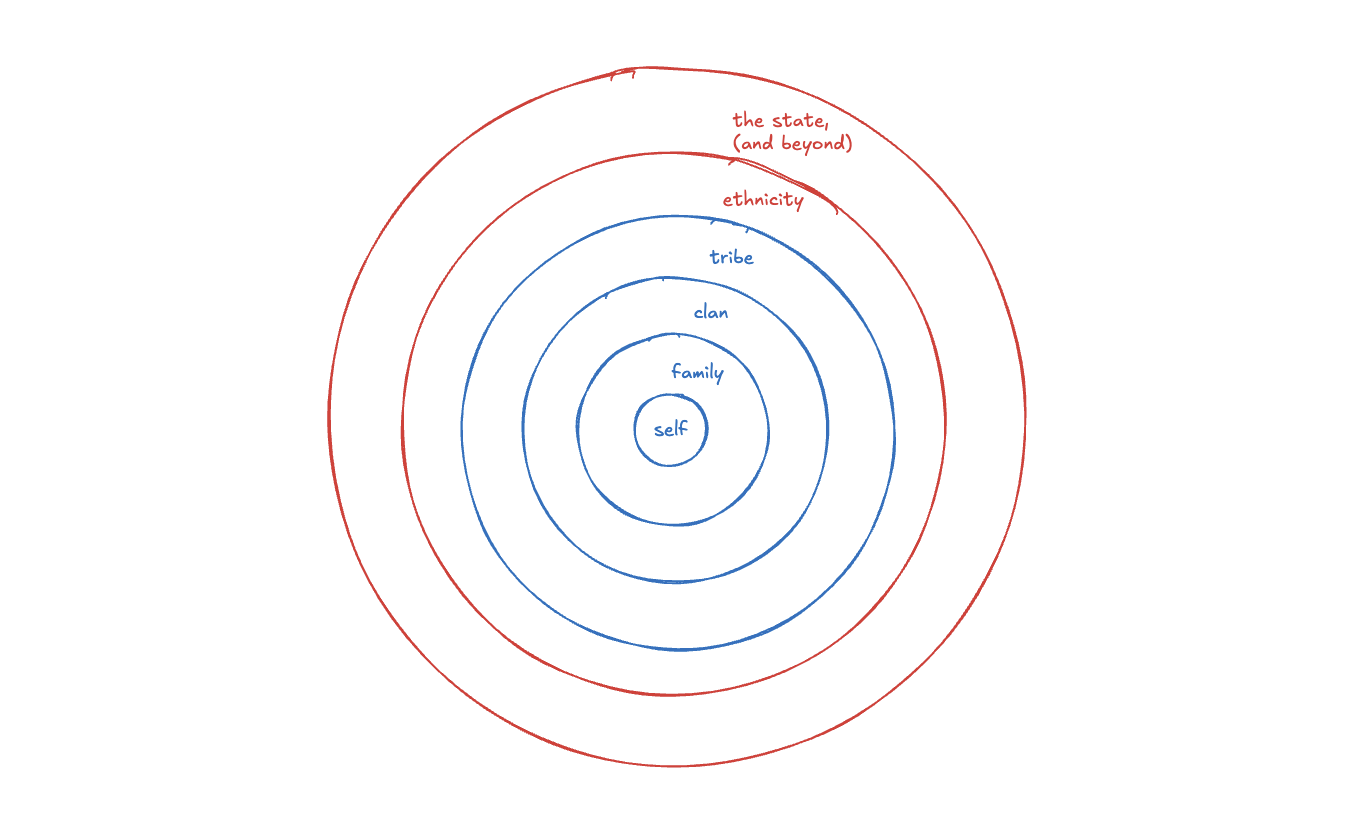
The same applies to states, markets, companies, and institutions. They should not be treated as objects of spiritual belonging. They should be treated as external environments that allow oneself and one's community to survive and act. While using available institutions, markets, and infrastructure, one should avoid depending too much on a single outside actor, and secure both the possibility of exit and alternative means.
The Definition of the Outside
In this view, the outside means people, organizations, and institutions that are not recognized as part of the extended self. This includes strangers, shallow acquaintances, business partners, companies, markets, administrative agencies, states, and other social institutions.
However, inside and outside are not fixed statuses. If one builds a long-term relationship with someone, and love, trust, memory, values, and shared stories emerge, that person may move inside. Conversely, even if someone formally belongs to the same group, if that person cannot be recognized as part of the extended self, that person remains closer to the outside.
Therefore, inside and outside are not statuses. They are states of relationship. Labels such as nationality, workplace, school, region, religion, or legal family can be reference points, but they do not decide the matter by themselves. As explained in Parts 1 and 2, what matters is whether one can feel the other person as part of oneself, and whether one can receive that person's happiness and loss as one's own.
Inside and Outside Use Different Principles
The greatest difference between inside and outside is how far one should involve oneself in the other person's life.
Toward people inside, if I feel that someone is acting destructively, I may intervene strongly. I may give opinions, persuade, and come into conflict. This is not because I want to own the person. It is because that person's happiness and loss are felt as close to my own happiness and loss.
Toward people outside, however, the basic idea is that they may live as they like. There is no reason to force one's own view of the right way to live onto unrelated others. Even if others live in ways that differ from one's values, there is no need for active intervention as long as they do not directly harm oneself or the inner community.
Therefore, this view is communal inwardly and liberal outwardly. It is deeply involved with the inside, but does not step too far into the outside. If these two layers are confused, one either becomes too cold toward the inside or too interventionist toward the outside.
Two-Layer Use of Collectivism and Individualism
Applying collectivist values inside and individualist values outside is not a simple compromise. In light of the long history of human society, it is one of the most stable ways to operate.
Families, clans, tribes, villages, merchant houses, professional groups, and similar communities have often demanded mutual aid and discipline internally. Raising children, supporting the sick and elderly, protecting shared assets, and passing on skills, names, and stories all become fragile if they are left only to individual free choice. Inner communities have continued by treating members not as completely isolated individuals, but as people who bear with one another, support one another, and intervene in one another's lives.
On the other hand, if that collectivism is extended without limit to the outside, it tries to interfere even in other people's lives, beliefs, and values. This easily approaches domination, assimilation, totalitarianism, imperialism, or religious coercion. Loyalty, discipline, and intervention may work as virtues inside. But when generalized toward the outside, they violate the dignity and freedom of others.
Conversely, if individualism meant for the outside is brought into the inside without change, the community becomes weak. If everything is handled only through contracts, individual freedom, and personal responsibility, child-rearing, elder care, support in hardship, and intergenerational inheritance become thin. Even inside, the possibility of exit and respect for dignity are necessary. But those alone do not form a house or tribe.
Therefore, the important thing is not to choose either collectivism or individualism as the only principle. The important thing is to operate collectivistically inside and individualistically outside. This is not a contradiction. It is a distinction in scope. By distinguishing toward whom, and to what degree, one should be involved, it becomes possible to combine community sustainability with liberalism toward the outside.
Basic Principles Toward the Outside
The basic principles toward outside people are these: do not interfere unnecessarily, do not violate the other person's dignity, keep promises, base cooperation on mutual benefit, and maintain the possibility of exit from the relationship.
Here, loving the other person is not a precondition for cooperation. Even if both sides have different purposes, they can cooperate where their interests overlap. Market transactions, contracts, joint projects, neighborly relations, and political alliances do not always require love or deep trust. What is needed is that the conditions are clear, performance can be expected, and exit is possible if the relationship breaks down.
I do not deny goodwill toward the outside. But if goodwill is placed at the center of action, one may treat someone one does not know well as if they were inside. This harms sustainability. In relationships with the outside, boundaries should come before goodwill, verification before expectation, and conditions before emotion.
Non-Interference
Toward the outside, non-interference is the basic principle.
As stated in Part 1, respecting dignity does not always mean non-interference. Inside, precisely because a relationship is important, one may strongly give opinions, stop someone, persuade them, and come into conflict. But that principle should not be extended without limit to the outside.
Outside people may have purposes, values, and lifestyles different from one's own. Even if their choices look irrational, one may leave them alone as long as they do not violate the survivability, freedom, or dignity of oneself or the inner community. The fact that another person looks foolish is not a sufficient reason to intervene in that person's life.
This is not coldness. It means not intervening in areas where one cannot take responsibility. If one has neither the will nor the resources to carry the life of an outside person, intervening only from a feeling of moral superiority easily violates that person's dignity.
Therefore, toward the outside, there is reason to intervene only when advice is requested, when a contract requires it, when clear harm or violation is occurring, or when the inner community is affected.
Dignity and Boundaries
Outside people also have dignity. Just because one does not recognize them as part of the extended self, it does not mean one may treat them as tools without personhood. They are subjects with purposes separate from one's own.
However, recognizing dignity and bringing someone inside are different things. Respecting a business partner and supporting that person like family are not the same. Recognizing the rights of a stranger and deeply committing to that person's life are also not the same.
In the outside, dignity means not controlling the other person unnecessarily, not deceiving them, keeping promised conditions, and leaving them the possibility of exit. Unlike inside, where dignity is protected through active involvement based on love, outside dignity is protected by maintaining boundaries.
When boundaries become unclear, one either exhausts oneself by treating the outside like the inside, or breaks relationships by treating the inside like the outside. Therefore, distinguishing toward whom and how much one should be involved is not coldness. It is a necessary recognition for sustaining relationships.
Trust and Verification
Inside, trust accumulates through long-term relationships, shared experience, and love. Outside, one does not begin with the same level of trust. Trust toward the outside is formed step by step through verifiable action, contracts, track records, reputation, collateral, and institutions.
In this sense, the basic attitude toward the outside is not "do not trust." It is "verify, then trust." If one only keeps doubting from the beginning, transactions and cooperation cannot happen. But placing trust without grounds also puts the inner community at risk.
One can maintain ongoing relationships with people and organizations that keep promises. Conversely, one should keep distance from people and organizations that disregard contracts, avoid explanation, make responsibility vague, or take away the other side's possibility of exit. In the outside, relationships should be maintained based more on consistency of action than emotional closeness.
Exchange, Contracts, and Cooperation
Relationships with the outside are based on exchange, contracts, and cooperation. This does not mean believing only in market principles. It means that subjects with different purposes form relationships where their interests overlap.
Exchange means that oneself and the other side give each other things that each side recognizes as valuable. A contract makes the conditions of that exchange or cooperation clear. Cooperation means achieving together, within the range of shared interest, goals that would be difficult to achieve alone.
What matters here is not to confuse cooperation with the outside and mutual aid inside. Mutual aid values the continuation of the relationship itself and the other person's survivability. Cooperation with the outside continues as long as the conditions are met. If the conditions collapse, it may end.
Therefore, in relationships with the outside, expected roles, what is provided, what is received, duration, termination conditions, and the scope of responsibility should be made as clear as possible. Relationships based on vague goodwill may work inside an inner community, but they easily break down outside.
Markets and Organizations
Markets are mechanisms that allow outside people to cooperate on a large scale. Even if people do not love one another, and even if they do not know one another's backgrounds, they can exchange through prices, contracts, institutions, and reputation. In this sense, markets are very useful.
However, markets are not the purpose. As stated in Part 1, institutions, property, and work are means for increasing happiness, self-sovereignty, survivability, and inheritability. Winning in the market itself must not become the final purpose. Markets should be used to maintain the inner community, obtain external resources, and increase options.
The same applies to companies and organizations. A company is a device that combines resources, technology, people, and information to achieve a purpose. Belonging to one can be useful, but it is not a place of spiritual belonging in itself. Treating the workplace like a family often blurs boundaries.
When relating to an organization, it is necessary to clarify what one provides and what one receives. If one can gain wages, experience, credibility, skills, networks, capital, or information, then it is reasonable to use the organization. But if loyalty to the organization itself becomes the purpose and harms the inner community or self-sovereignty, one must take distance again.
The State and Law
The state strongly defines people's living environment through violence, law, taxation, infrastructure, education, currency, diplomacy, and more. Therefore, the state cannot be ignored. But the state does not need to be placed at the center of the extended self.
As stated in Part 2, relationships in which people trust each other on the basis of law defined by the state or international society are basically outside relationships. Law is mutual trust backed by state violence. It is an outsourced means of trust. This is useful, but it is different from love or inner trust.
Law should be used. Institutions should also be used. Administrative services, social security, education systems, courts, currency, contract enforcement, and infrastructure are important for increasing the survivability of oneself and one's community. At the same time, one must not assume that the state or institutions will always maximize one's happiness.
The state is an environment, a tool, and sometimes a constraint. I do not deny that some people need the state as a source of belonging or symbolism. But in this view, belonging to the state is not the highest purpose. The purpose is to make oneself, the people one cares about, and future generations happy over the long term. The state matters only insofar as it serves that purpose.
Dependence and Self-Sovereignty
The thing to watch most carefully in relationships with the outside is excessive dependence on a single outside actor. If one depends too much on a specific company, workplace, state, market, platform, or relationship, the possibility of exit is lost.
When the possibility of exit is lost, bargaining power declines. When bargaining power declines, freedom shrinks. When freedom shrinks, the survivability and dignity of the inner community are also harmed. Therefore, using the outside is important, but concentrated dependence must be avoided.
Self-sovereignty does not mean complete independence from the outside. In modern society, it is unrealistic to be completely independent from states, markets, infrastructure, technology, and other people. What matters is having alternatives, having multiple options, controlling some of the resources one needs, and not becoming immediately unable to survive if a relationship breaks down.
Diversifying sources of income, housing, food, technology, knowledge, human networks, legal knowledge, assets, means of movement, and means of gathering information increases self-sovereignty in relation to the outside. This is not isolationism. It is a condition for continuing to use the outside.
When the Outside Enters the Inside
An outside person may enter the inside over time. A business partner may become a friend. A coworker may become part of a tribal community. A person met by chance may, through a long-term relationship, trust, shared experience, and inherited stories, come to be recognized as part of oneself.
However, this should happen carefully. If one treats an outside person as inside too early, one places excessive expectations on that person before they have the will or ability to bear that relationship. Conversely, if one continues to treat a trustworthy person as outside forever, one may lose a community that could have been formed.
Whether someone enters the inside is not decided only by a checklist. As stated in Part 2, intuition remains important. One should look at the density of conversation, values, consistency of action, behavior in difficult situations, will to maintain the relationship, ability to protect the dignity of others, and whether the person consumes community resources one-sidedly.
Do Not Hold Hostility Toward the Outside
Treating the outside as outside does not mean holding hostility toward it. Strangers, companies, markets, states, and institutions do not exist only for oneself. At the same time, they do not necessarily exist as enemies.
In the outside, some people can be cooperated with, while others should be kept at a distance. Some institutions can be used, while others should be avoided. What matters is not to treat the whole outside as either good or evil.
To protect the inside, one must have relationships with the outside. Many resources, information, technologies, credit, legal protections, education, medical care, and trade opportunities exist outside. If one rejects the outside completely, the survivability of the inside also declines.
Therefore, toward the outside, one should hold a sense of distance rather than hostility. Cooperate when necessary, do not interfere when unnecessary, leave when dangerous, and use what is useful. This is not cruelty. It is the practice of not confusing inside and outside.
Summary
In this view, inside and outside are handled by different principles. Inside, there are love, mutual aid, intervention, and inheritance. Outside, there are boundaries, verification, agreement, exchange, and the possibility of exit. In other words, collectivist values are applied inside, and individualist values are applied outside.
This does not mean looking down on outside people. Outside people also have dignity. Promises should be kept, and cooperation is possible. But the outside should not be treated like the inside. Conversely, the inside should not be treated like the outside.
States, markets, companies, and institutions are not objects of spiritual belonging. They are external environments that allow oneself and one's community to survive and act. Use them, verify them, distribute dependence, and secure the possibility of exit. The purpose is not to be loyal to them. The purpose is to make oneself, the people one cares about, and the people they care about happy over the long term, across both distance and time.
The core ideas from Part 1, the inner community from Part 2, and the sense of distance toward the outside described in this article do not contradict one another. Rather, to form the inside strongly, boundaries with the outside are necessary. To use the outside properly, the purpose of the inside is necessary. The practical point of this view is not to confuse purpose and means, and not to confuse the range of love with the range of exchange.