Part 2: How to Relate to People in the Inner Layer
In the first article, I wrote about the basic and conceptual ideas behind this view. In this second article, I write about how to build relationships with the people I define as the "inner layer," in order to achieve the highest purpose described in Part 1: to make myself, the people I care about, and the people they care about happy over the long term, across both distance and time.
How to Understand Society
Before discussing how to relate to people in the inner layer, I will first describe how this view understands society. As explained in Part 1, the self is not closed inside the body. It extends to others through love, genes, memory, values, and inherited stories. This extension is not uniform. Its strength changes depending on the depth of the relationship. Therefore, human relationships should not be divided simply into "inside" and "outside." They should be understood as continuous layers.
Roughly speaking, psychological distance increases in the following order.
Self -> family -> clan -> tribal community including close friends -> ethnic group -> state and beyond
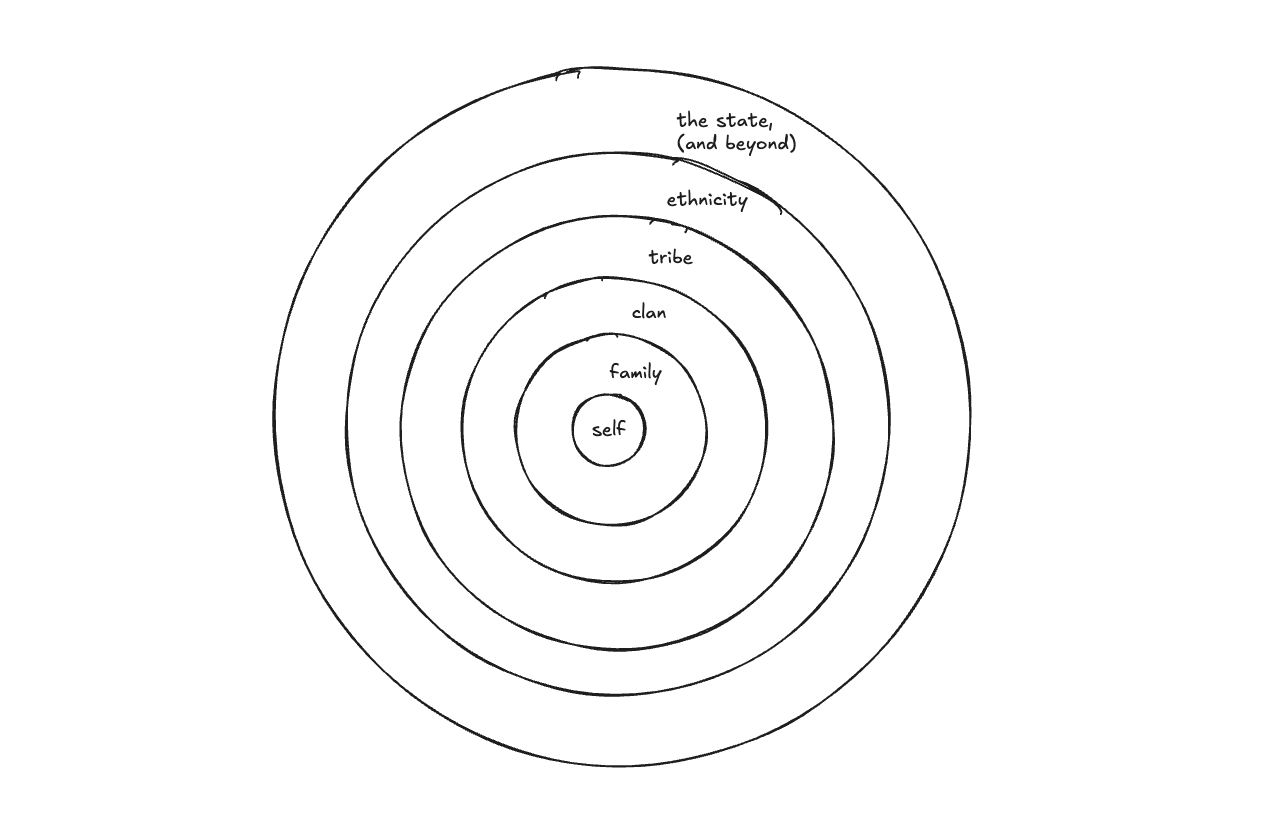
The closer someone is to the inside, the stronger the trust, concern, support, and intervention become. The farther someone is, the thinner the relationship becomes, and the weaker the basis for involvement becomes. Here, "inside" does not mean a formal label of belonging. It is based on the degree to which one can feel the other person as part of oneself. Blood relation is a strong connecting factor, but it is not decisive. Through long-term relationships, shared experience, values, trust, love, and inherited stories, non-blood relatives can also enter the inner layer.
This layered structure is also a first step in organizing toward whom, and with what intensity, the highest purpose from Part 1 should be practiced. The family is the smallest social unit that carries survival support, child-rearing, and inheritance. The clan and tribal community are networks that expand this mutual aid.
On the other hand, ethnic groups and states are usually closer to the outside as objects of belonging, even if in practice a particular clan or tribal group often becomes the core of rule or symbolism. As stated in Part 1, the state and institutions are not purposes. They are means, or environments. This article deals with the inner area where the extended self actually operates: the self, family, clan, and tribal community.
After World War II, an order based on international law came into use. But in general, relationships in which people trust each other on the basis of "law defined by the state or international society" belong to the outside. Relationships in which people trust each other by other means belong to the inside. This is because law defined by the state or international society is trust backed by state violence. It is a state in which the means of trust has been outsourced.
Part 1 was about how to relate to the self. This second article is about how to relate to the family through the tribal community. The third article will be about how to relate to the ethnic group, the state, and anything beyond them.
The Definition of "Inside"
In this view, "inside" means a relationship in which one feels the other person as part of oneself, receives that person's happiness as one's own happiness, and receives that person's loss as something close to one's own loss. It can also be described as the area where love, as defined in Part 1, operates: treating the other person as part of oneself and feeling that person's happiness as one's own.
Inside and outside are not binary. As described above, they are continuous layers. The closer someone is to the inside, the stronger the trust, concern, support, and intervention become. The scope of this article is the range where the extended self is likely to operate in practice: from family to clan to tribal community, including close friends.
Where should a person be placed, and how far inside should they be? We intuitively process many kinds of information: the density of conversation, the way words are used, values, the timing of meeting, and the feeling of wanting to be together. People who truly have friends or family already have this intuition. Therefore, it is reasonable to trust it.
What Determines the Inner Layer
Formal belonging does not determine how close someone is to the inside. Several factors overlap, including love, shared experience, values, and trust. Among them, as Part 1 explained, human beings are formed by genes and stories, so these two are especially strong paths of inheritance. Since the detailed concepts were already described in Part 1, this section clearly states who is defined as inside and how.
Inheritance Through Genes
Genes are mainly inherited by descendants. When a part of the self continues beyond the body and into the future through descendants, that person is likely to enter the inner layer as an extension of the self through genes. Blood relation is a strong connecting factor.
However, it is not a sufficient condition. Even with blood relation, if the relationship is weak, psychological distance can remain far. Kinship as a form does not always match kinship as part of the inner layer. For example, I have eight siblings, but because we were raised under different disciplines, I do not strongly recognize them as part of my inner layer.
Inheritance Through Stories
Stories are not limited to genes. Values, memories, ways of living, and ways of seeing the world can also be inherited by friends, students, companions, and members of a community. If I can say of someone, "If this person lives on, part of my story will remain in the world," then I recognize that person as an extension of myself across time, and that person enters the inner layer.
Therefore, even without blood relation, a close friend, a student, or someone who has acted together with me for a long time can become part of the "house" or tribe in a deep sense. If genes are the bodily extension of the self through time, stories are a path that extends the self across both space and time.
Basic Principles for the Inner Layer
The common principles toward people in the inner layer are love and dignity. Love means treating the other person as part of oneself and wanting that person's happiness. Dignity means treating the other person as an independent subject. The ideal relationship is deep involvement without ownership.
The basis for helping is not duty. It is voluntary will: "I do it because I want to." At the same time, this does not mean accepting every demand from someone one loves. Supporting someone and taking on unlimited burden are different things. Loving someone is compatible with protecting one's own interests and dignity.
The closer a layer is to the inside, the stronger the trust, concern, support, and intervention become. Below, I describe the differences in how to relate to each layer, based on this common principle. Mutual aid systems, conditions for participation, conflict adjustment through will, and the role of the head of a house or tribe will be discussed later.
The Self
The self was already discussed in Part 1. The main points are that the self is not closed inside the body and can be extended, and that the basis of action is voluntary. Relationships with others in the inner layer should be understood as the operation of this extended self.
Family and Clan
The family is the closest layer within the inner layer. Survival support, child-rearing, daily discipline, and inheritance across generations all operate here as the foundation of life. As the smallest social unit, involvement and intervention tend to be strongest here. Even so, family members are not owned. The other person is an independent subject, and involvement through love must coexist with respect for dignity.
The clan stands on the same principles of love and dignity as the family, but its functional center is different. Daily density is usually weaker than in the family. Instead, the clan carries blood relation, inheritance, and wider horizontal mutual aid. If the family is the core of present life, the clan is the layer that extends that core across time and number of people. The frequency and depth of intervention are often lower than in the family, and a formal kinship label alone does not make someone part of the inner layer. If the actual relationship is thin, psychological distance remains far even with blood relation. For this reason, both blood relation and shared discipline are important for the inner layer.
Tribe, Including Close Friends
In a tribal community, the main path of connection is story. People who share values, memories, ways of living, and ways of seeing the world, and whom I can feel as people through whom part of my story remains, belong here. Since the connection is not centered on genes, joining and leaving tend to depend more on agreement and will.
The basic principles are the same as with family and clan: love and dignity. But the intensity of intervention is generally weaker than with family. One is deeply involved and may give opinions and persuade when needed, but one does not own the other person, and the possibility of leaving the relationship remains. Being a friend does not mean abandoning involvement. Being a blood relative does not mean being treated the same as a tribe member. The intensity changes according to the distance of the layer.
Will
In Part 1, I described institutions, property, states, work, and similar things as transformed forms of people's will, including the will of rulers. In Part 2, I also use will as an indicator for adjusting conflicts of opinion among people in the inner layer.
In important relationships, I accept active intervention, persuasion, and conflict. At that time, it is important not to end the matter simply by saying, "The person involved should decide because it is their own matter." What matters is how seriously all the people who observe the action or decision hold their will. Here, will includes strength of intention, continuity, action, willingness to explain, willingness to negotiate, readiness to accept loss, and willingness to maintain the relationship.
If both sides want to maintain the relationship but cannot compromise on a certain choice, the conflict becomes a conflict between wills. If one side gives up easily, while the other side continues for a long time to explain, act, and pay costs, then the latter will should be treated as stronger. Seriousness should be judged not only by words, but also by continuous action.
This is often misunderstood, but other people may sometimes have stronger will than the person directly involved.
The Limits of Will
Will does not mean that the person who argues most strongly wins. Will is the degree to which a person accepts costs and shows their intention to the world. It is not the ability to force costs onto someone else.
If there is no distinction between forcing costs onto others and accepting costs oneself to express will, involvement through love turns into control or attachment. It also contradicts the basic principles of protecting dignity and not owning others.
Therefore, adjustment through will applies only to conflicts of will within a relationship that both sides still want to maintain. If the other person understands the cost of losing the relationship and still chooses to leave, that will must be accepted. Allowing final exit is the last means of protecting the other person's dignity.
Participation in the Community
An inner community is not an unconditional mutual aid group. Even if love makes one feel others as part of oneself, one cannot internalize everyone and support them without limit. Participation has conditions, maintenance requires will, and expansion requires evaluation. Below, I describe principles of participation common to families, clans, and tribal communities.
Conditions for Participation
A community does not internalize everyone unconditionally. When welcoming someone into the inner layer, at least the following points matter.
Can this person be trusted? Is there mutual will to maintain the relationship? Can this person protect the dignity of others? Can this person help when needed? Will this person avoid consuming the community's resources one-sidedly? Can this person share stories and values to some degree? As stated above, however, the final judgment of who belongs inside is made by the intuition of the people who belong to the community.
Conversely, serious deception, violence, embezzlement of resources, intentional harm toward other members, and actions that destroy the community itself must be distinguished from ordinary disagreements and differences in values. The problem is not whether someone's ideas are different. The problem is whether the person has destroyed the trust that makes the community possible. A person whose trust has been broken cannot be kept inside by formal belonging alone.
Free Riders in the Community
In a mutual aid community, members who receive benefits but do not bear burdens become a problem. This harms sustainability. Therefore, it is not necessary to demand the same amount of contribution from every member, but it is necessary to demand the will to maintain the community.
The distinction here is important. Supporting a person whose ability to contribute is temporarily low because of illness, age, childcare, or similar reasons is different from allowing someone who can contribute to continue consuming resources one-sidedly. The former is the essence of mutual aid. The latter is free riding. If the latter is accepted without limit in the name of love, the survivability and dignity of those who support the community are reduced, and the whole community becomes weaker.
Asymmetry Within the Community
Contributions within a community do not have to be identical. Some people may earn money, some may care for children, some may provide knowledge, some may support the elderly, and some may build networks. What matters is not that everyone does the same thing, but that the necessary functions of the community as a whole are fulfilled.
Therefore, equality should not be defined as identical roles. Asymmetrical role distribution is not evil in itself. It becomes evil when asymmetry expands into economic, personal, or residential domination, and when the possibility of exit or dignity is lost. Differences in roles may be accepted, but equality as subjects must not be abandoned.
Mutual Aid
Family, clan, and tribe are not enough if they are only emotional connections. They should be formed as mutual aid systems that actually function. They should create a state in which childcare, education, emergency support, housing, financial support, information, human networks, elder care, knowledge, work, and similar things can be provided to one another. The purpose is that one person does not have to bear every risk alone.
Children deserve special mention. Children are not born after choosing their family or community. The premise is different from relationships between consenting adults. Therefore, within mutual aid, providing children with safety, and providing discipline, knowledge, and relationships for living in the wider society, should have high priority. It is desirable not to trap child-rearing inside a closed project of only two parents, but to create a form in which grandparents, relatives, friends, and adults in the community can support them.
Property does not have to be fully communal. It is better to separate individual property and common property. Individual property protects freedom, the possibility of exit, and self-sovereignty. Common property is used for the long-term purposes of the community, such as housing, child-rearing, emergency support, and inheritance across generations. In the future, a three-part classification will be needed: "mine," "yours," and "the house's." A state in which one specific person can dispose of the house's assets according to mood weakens sustainability.
Exit is also not enough in form alone. If someone says, "You may leave," while taking away property, housing, children's living conditions, and human relationships, then the actual possibility of exit is low. Mutual aid is not a device for binding people. It is a device for increasing survivability while someone is inside, and for leaving enough room to survive even when someone leaves.
Head of the House and Head of the Tribe
The Role of the Head
A family or tribe may have a central person. In some situations, a center can make things function more easily, such as speeding up decisions, serving as an external contact point, adjusting disputes, and managing shared resources.
However, being the central person and owning the community itself are different things. The role of the head of a house or tribe is to operate the community, not to privatize it. Even with deep involvement through love, members should not be treated as private property. The limits described in Part 1 and in the previous sections, dignity, exit, and the limits of will, apply here as well.
Limits on the Head
As a community continues over time, assets, information, relationships, and decision-making can concentrate in the central person. This is a single point of failure, and it can also become the entrance to a structure of domination. Therefore, the head of a house or tribe must also be bound by the rules of the house or tribe.
In the future, mechanisms will be needed so that shared assets, treatment of children, joining and leaving, inheritance, and major decisions cannot be changed by one person's mood alone. Persuasion through will may be accepted, but "victory" through violence, threats, economic domination, or obstruction of exit should not be accepted. A center is useful, but the center must not become the purpose.
For this reason, it is necessary to create something like a family constitution to prevent the head of a house or tribe from running out of control.
The Meaning of a Large House or Large Tribe
"Making the house larger" or "making the tribe larger" does not mean simply increasing the number of people. It means forming a community that can increase survivability and options for each member. If the number of people increases but each person's standard of living or freedom declines, simple expansion has no meaning.
The standard of evaluation is not form. The question is whether the institution or scale has increased the real options and long-term happiness of the members. Expansion that increases only one side's freedom while reducing the other side's self-determination is a failure. Expansion that increases the number of children while worsening the care each child receives is also a failure. The goal is not to maximize the size of the house or tribe, but to maximize its quality.
This is also another way of stating the highest purpose from Part 1. To make the people one cares about happy across distance and time, what matters first is not blindly expanding the outer edge of the network. What matters first is that mutual aid inside actually functions, inheritance is possible, and the possibility of exit remains. A small community that shares the same principles is stronger than a large crowd that does not.